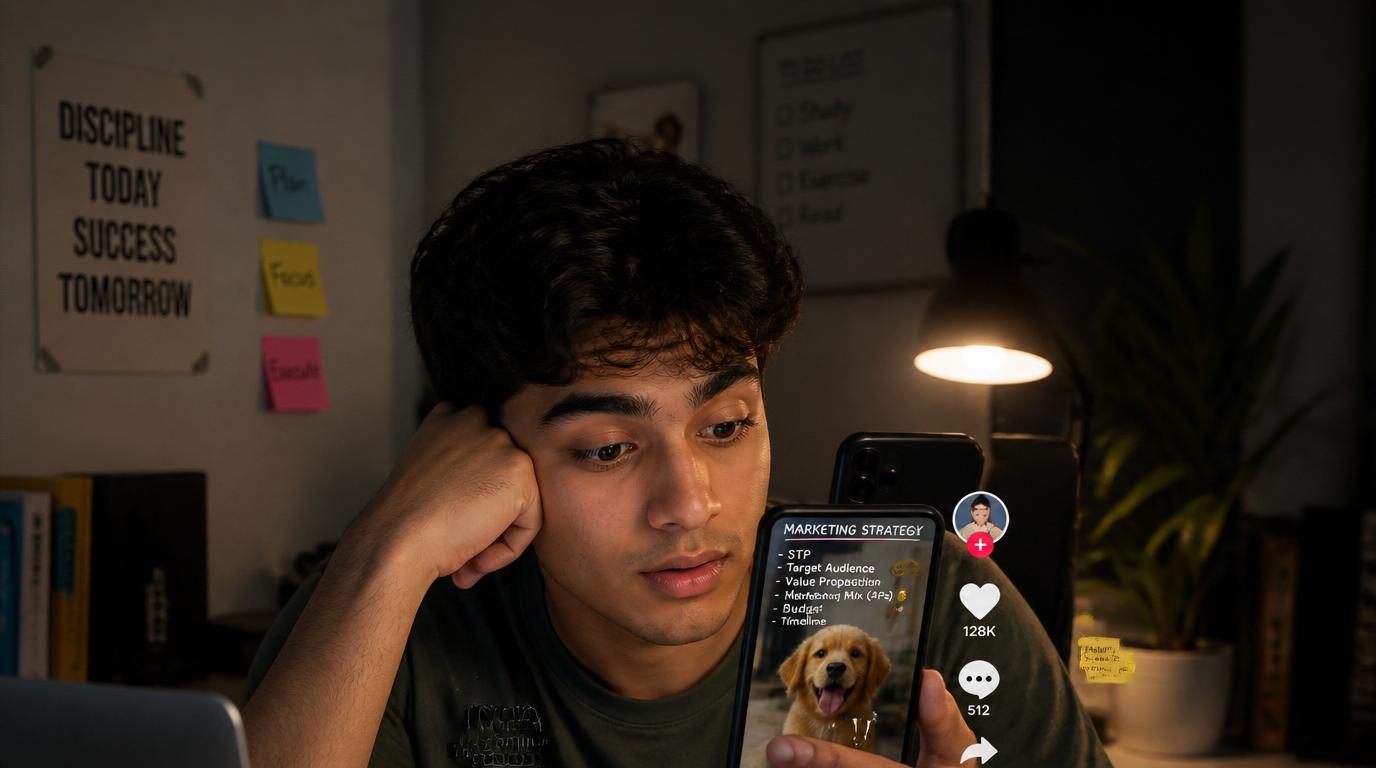
A constant stream of short videos can train the brain to seek instant rewards, making deep focus increasingly difficult.
Introduction
Have you ever opened Instagram or YouTube for “just five minutes” and suddenly realized that an hour has passed?
You’re not alone.
Short-form videos attention span and have become one of the most popular forms of entertainment in the world. Platforms like Instagram Reels,Facebook reels,YouTube Shorts, and TikTok deliver endless streams of content designed to capture attention instantly. While these platforms are entertaining and often informative, they may also be changing how our brains focus, learn, and process information.
Many people today struggle to read books, complete tasks without distractions, or stay focused during work and study sessions. Activities that once felt normal now seem boring or difficult. As a result, attention spans appear to be shrinking, and mental fatigue is becoming increasingly common.
The problem isn’t necessarily a lack of discipline. Instead, it may be the result of constant digital stimulation.
In this article, we’ll explore how short videos affect attention span, why they feel so addictive, and what practical steps you can take to rebuild your ability to focus.
What Is Attention Span and Why Does It Matter?
If you’ve noticed that concentrating on books, work, or conversations has become more difficult, you’re not alone. We explored this problem in greater detail in our article on Why Our Brain Can’t Focus Anymore.
https://sandeepblogging.com/why-our-brain-cant-focus-anymore/
Attention span refers to the amount of time a person can concentrate on a task without becoming distracted. It plays a crucial role in learning, productivity, memory, creativity, and decision-making.
Whether you’re studying for an exam, reading an article, working on a project, or having a meaningful conversation, attention is essential.
Strong attention skills help us:
•Learn new information more effectively
•Complete tasks efficiently
•Improve memory retention
•Build deeper understanding
•Increase productivity
•Strengthen problem-solving abilities
However, attention is like a muscle. If it is constantly interrupted, it becomes weaker over time.
This is where short-form content enters in the picture.

Infinite scrolling keeps users engaged far longer than they originally intend.
Why Short Videos Feel So Addictive
Short videos are specifically designed to keep users engaged.
Each clip delivers something new within seconds:
•A new story
•A new joke
•A new fact
•A new emotional reaction
The brain loves novelty.
Every swipe creates anticipation because the next video could be even more entertaining than the last. This endless cycle encourages users to keep scrolling.
Unlike reading a book or watching a long documentary, short videos require very little effort. They provide instant rewards without demanding sustained concentration.
As a result, the brain gradually becomes accustomed to receiving constant stimulation.
Activities that require patience and deep focus can start to feel less rewarding in comparison.
The Science of Dopamine and Attention
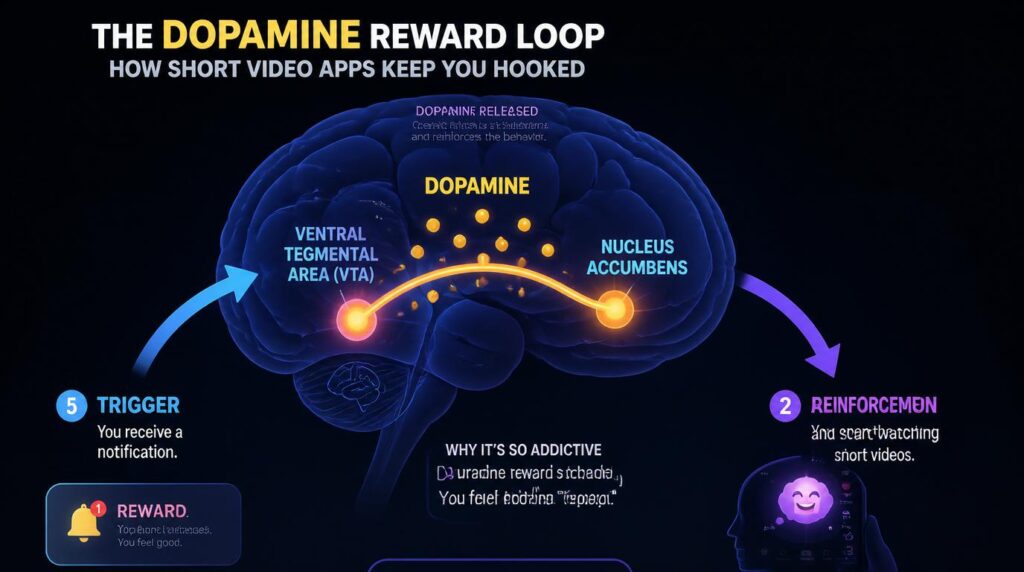
Every swipe can trigger a small dopamine reward, encouraging continued scrolling.
To understand why short videos are so powerful, we need to understand dopamine.
Dopamine is often called the brain’s reward chemical.
Every time you encounter something exciting, funny, surprising, or emotionally stimulating, your brain releases dopamine.
Short videos are specifically designed to trigger these dopamine spikes repeatedly.
For example:
•Funny video → dopamine
•Motivational clip → dopamine
•Cute animal video → dopamine
•Shocking fact → dopamine
Within minutes, your brain experiences dozens of mini rewards.
As a result, your brain starts craving more stimulation.
This creates a habit loop:
•Open app
•Watch video
•Get dopamine
•Swipe
•Repeat
Over the period time, normal activities begin to feel less rewarding because they cannot compete with the constant stimulation of social media.
The Hidden Productivity Cost
Most people underestimate how much time they spend on short videos.
Imagine:
•30 minutes daily scrolling
•7 days a week
That equals:
•210 minutes weekly
•910 minutes monthly
•Over 180 hours annually
That’s nearly an entire month of full-time work spent consuming content.
Now imagine investing those hours into:
•Learning a skill
•Building a business
•Writing a blog
•Exercising
•Reading books
The opportunity cost is enormous.
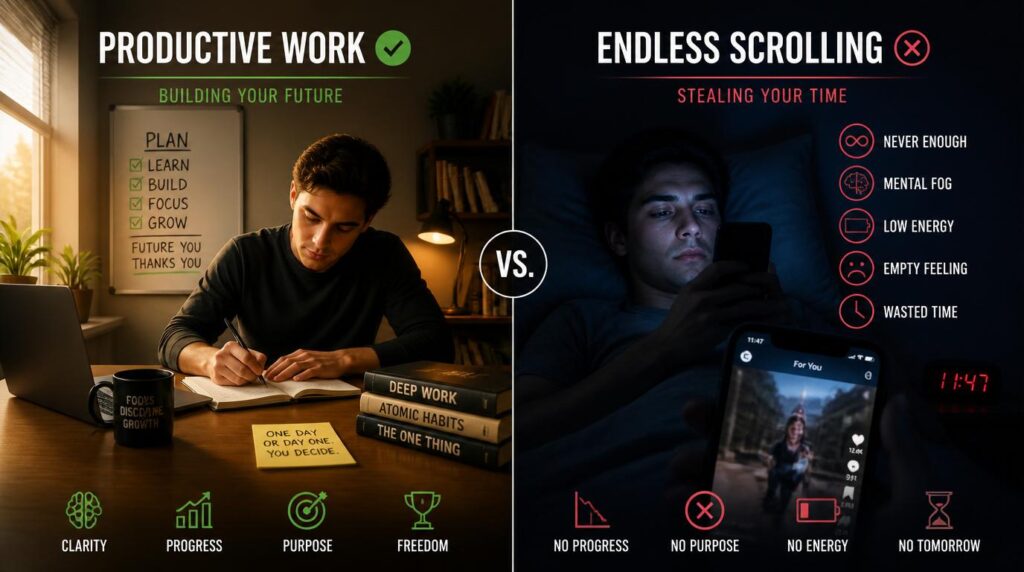
Every hour spent scrolling is an hour not invested in personal growth.
How Short Videos Affect Memory
Short-form content doesn’t just impact focus.
It can also affect information retention.
Because videos move rapidly from one topic to another, the brain has little time to process information deeply.
For example:
You might watch:
•Productivity tips
•Cooking hacks
•Travel clips
•Business advice
•Comedy sketches
All within 10 minutes.
While entertaining, very little of that information is retained.
Deep learning requires:
•Reflection
•Repetition
•Focus
Short videos often provide none of these.
The Mental Health Impact
Excessive short-form content consumption can contribute to:
https://www.who.int/health-topics/digital-health
Anxiety
Constant stimulation keeps the mind active and restless.
Comparison
Seeing curated lifestyles can create unrealistic expectations.
Reduced Satisfaction
Ordinary life may feel less exciting compared to the endless stream of entertaining content.
Sleep Problems
Late-night scrolling can disrupt healthy sleep routines.
Many users find themselves scrolling long after they intended to stop.
Signs You May Have a Short-Video Addiction
You might be experiencing unhealthy consumption habits if:
•You open social media automatically.
•You lose track of time while scrolling.
•Reading feels difficult.
•You check your phone constantly.
•You struggle to focus on work.
•You feel bored without stimulation.
•You scroll before sleeping and after waking up.
If several of these sound familiar, it may be time to reset your digital habits.

Nighttime scrolling often contributes to poor sleep quality and reduced focus the next day.
How to Fix Your Attention Span
The good news is that attention is trainable.
Just as your brain adapted to short-form content, it can adapt back to deeper focus.
1. Set Daily Limits
Most smartphones allow screen-time controls.
Start by limiting:
•Reels
•Shorts
•TikTok
to 45-90 minutes daily.
Gradual reduction works better than quitting suddenly.
2. Create Phone-Free Zones
Avoid using your phone:
•During meals
•During study sessions
•In meetings
•One hour before sleep
These boundaries reduce mindless scrolling.
3. Read Every Day
Reading is one of the best ways to rebuild attention span.
Start with:
•10 pages daily
•Then 20 pages
•Then 30 pages
Consistency matters more than volume.
4. Practice Deep Work
Choose one important task.
Work on it without distractions for:
•25 minutes
•Then 45 minutes
•Then 60 minutes
Over time, your concentration improves significantly.
5. Turn Off Unnecessary Notifications
Constant notifications can interrupt deep work and increase mental fatigue. To understand the psychological impact, read our guide on Hidden Stress Behind Notifications.
https://sandeepblogging.com/hidden-stress-behind-notifications/
Notifications constantly interrupt focus.
Disable alerts from:
•Social media apps
•Shopping apps
•Entertainment apps
Keep only essential notifications.
6. Replace Consumption With Creation
Instead of spending all your time consuming content, start creating.
Examples:
•Write blogs
•Create videos
•Learn graphic design
•Build a website
•Learn digital marketing
Creation develops focus while providing long-term value.
7. Take Regular Dopamine Detox Breaks
A dopamine detox doesn’t mean avoiding all pleasure.
It means reducing excessive stimulation temporarily.
Try:
•Walking
•Reading
•Journaling
•Meditation
•Exercise
Even a few hours away from social media can reset your mental state.

Even short breaks from social media can help reset the brain’s reward system.
Benefits of Reducing Short-Video Consumption
Many people notice improvements within a few weeks.
Common benefits include:
•Better focus
•Increased productivity
•Improved memory
•Better sleep
•Reduced anxiety
•Higher motivation
•More free time
•Greater life satisfaction